Updated July 10, 2025 02:22PM
4 A.M. Run, Eat, Fast Until Sunset. What It’s Like Training Through Ramadan.
From February 28 until March 29, nearly two billion Muslims around the world observe the holiday by abstaining from food and drink during daylight—including many dedicated runners.
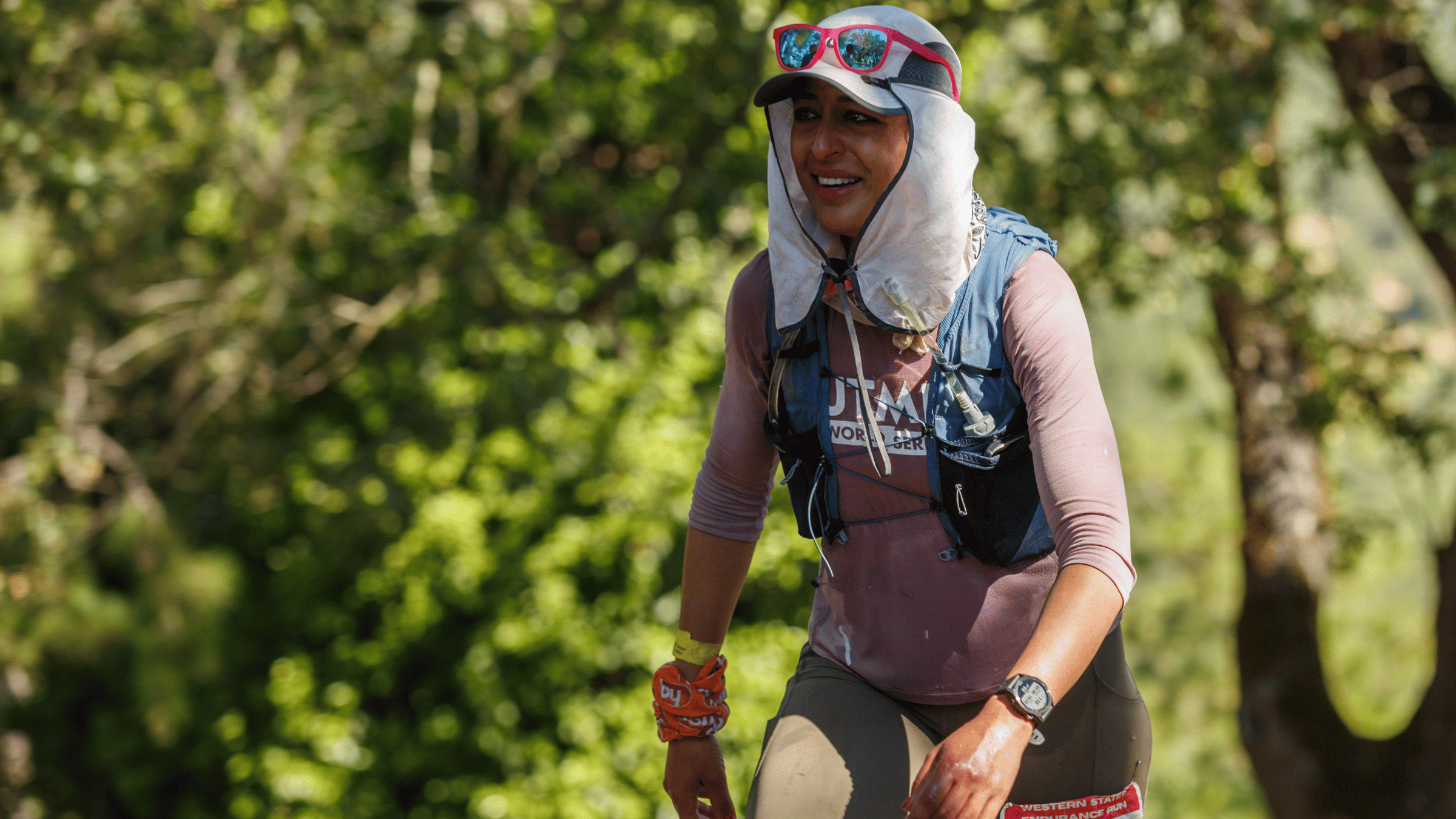
(Photo: Courtesy Hebah Hefzy)
It’s 3 A.M. when Hebah Hefzy rolls out of her bed in Detroit. She has a long run ahead of her that she needs to finish before sunrise, so she has enough time to eat a protein-rich suhoor, the pre-dawn meal of Ramadan. For her, that consists of oatmeal with peanut butter and nuts. Then her 12-hour fast begins. Those hours are a period devoted to prayer, personal growth, and reflection, all in the spirit of fulfilling a commandment from God and disconnecting from an increasingly materialistic world.
Hefzy made history last year as the first Hijabi—a Muslim woman who follows the religious practice of wearing a head covering—to finish the Western States 100. She does it all through her job as a vascular neurologist until iftar, the evening meal that ends the day’s fast. Tomorrow, the 42-year-old doctor, runner, and mom of three will do it all over again.
From the evening of February 28 to March 29, nearly two billion Muslims around the world observe the holiday by abstaining from food and drink during daylight hours. It’s considered by Muslims to be one of the holiest on the Islamic calendar. But marathon training doesn’t stop for Ramadan.
ADVERTISEMENT
Let’s face it: Fasting for about 12 hours a day for a month is not an ideal situation for any runner. But for many Muslims—including gold medalist runners Sifan Hassan, Mo Farah, Hicham El Guerrouj—running during Ramadan is simply woven into the fabric of their lives, and over many years they’ve figured out how to make it work.
Going with the Flow
Hassan turned heads when she won the 2023 London Marathon in her marathon debut despite stopping twice. Even more impressively, she raced just three days after Ramadan ended. This year, Hassan, 32, returns to the London Marathon on April 27 with some well-earned wisdom.
“All Muslims do Ramadan for the sake of Allah Subhanahu Wa Ta’Ala. But it is also great that we exercise during Ramadan because we will get benefits into our body and to our spirit also,” she said recently. “Ramadan is one of the greatest resistances for the body and also the mental and spiritual.”
For some like Rahaf Khatib, an RRCA-certified running coach based just outside of Detroit in Farmington Hills, the key is flexibility. In 2018, she became the first Syrian to complete the World Marathon Majors and has become a public advocate for Muslim athletes. She says observing Ramadan has changed her perspective on training as she’s gotten older.
“I used to be so adamant about getting my workout in no matter what, even during Ramadan,” she says. “And now I’m more lenient as I’m getting over 40.”

In other words, if she only has the energy to go for a gentle walk before Iftar or has to skip a run entirely, then she won’t push her body to do more than it can. She generally keeps up her cardio, but will scale back on anaerobic training and VO2 tempo work. She also adjusts her strength training to work with lighter weight and higher reps. The spiritual growth of the holiday comes first. Earthly desires, such as training, come second.
ADVERTISEMENT
“This is a time to listen to your body more than ever,” she says. “Every day is different. Your energy levels will go up and down. You have to give your body time to adjust.”
Despite (or perhaps because of) the fast, nutrition is key during Ramadan. Khatib focuses on hydration, incorporating electrolytes to get the biggest “bang for her buck.” She also eats hydrating soups, high-protein greek yogurt, and oatmeal. These foods help her maintain her energy levels throughout the day.
Hefzy emphasizes the importance of drinking a lot of water between sunset and dawn to avoid dehydration during the roughly 12 to 16-hour daily fast. Her rule of thumb is to drink approximately two liters of water during that period.
“After a week, it’s amazing how much your body adjusts,” she says. “Your stomach is going to shrink so much, especially when you hit the last third of Ramadan.”
ADVERTISEMENT
Making the Most of the Moment
Khatib has found that movement actually makes fasting easier. She’ll try to time finishing her workouts with about 10 minutes until it’s time to break the fast so she can start refueling her body shortly after the session. But flexibility, she says, is key. She recognizes that whatever works during the first half of Ramadan might not work for the second half.
Mo Abdin is a 29-year-old running and strength and conditioning coach from London who competes at a high level in everything from multi-day desert stage races to road marathons. He fits in his training whenever he can, with no clear preference between an early morning workout or something in the evening after breaking fast. Haroon Mota, Founder and Director of the London-based Active Inclusion Network, says he trains just before Iftar, so he can immediately rehydrate and refuel after his workout.
“My advice is to experiment and find a schedule that suits your energy levels,” Mota says. “Some people thrive with early morning workouts before Suhoor, while others feel better training after Taraweeh prayers. Every day in Ramadan is different—what feels manageable in the first week may feel different in the last 10 days, so it’s important to listen to your body and adapt.”
ADVERTISEMENT
Hefzy shares that sentiment. She’s trained during Ramadan for nearly a decade. How she’s trained, however, has shifted with the seasons of her life, like when her children were younger.
“When they were babies, I would start my workout right before it was time to eat and break my fast during my run,” she says. “For people who don’t have families and kids and have the luxury of doing whatever they want, that’s actually a really good idea. You get your warmup done and start getting in nutrition for the rest of your workout.”
Now, she says she always does her workouts in the morning when she can have nutrition because that’s how she’s able to make the most of that run. This, she believes, has allowed her not only to maintain her fitness during Ramadan, but to increase it.
“When I started shifting anything that was not easy to the really early morning hours it made a huge difference,” she says.

ADVERTISEMENT
The Power of Mutual Support
Training as a Muslim runner, let alone during Ramadan, was isolating for Mota. That’s why he started the Ramadan Challenge through the Active Inclusion Network, an organization dedicated to making the outdoors and endurance sports more diverse, inclusive, and welcoming for everyone with a special focus on Muslims cyclists, hikers, and runners.
“I’ve been an athlete for many years, and during that time, I often felt a sense of loneliness in the spaces I was navigating—whether it was in endurance sports, outdoor adventures, or trail running,” he says. “I knew that the power of community would make all the difference.”
ADVERTISEMENT
So he launched Muslim hikers and Muslim runners on Instagram and saw rapid growth with global interest and engagement. “It highlighted just how much people needed spaces where they felt seen, included, and empowered.”
Each year, Mota promotes the Ramadan Challenge, a virtual event started in 2020 during the pandemic in response to race cancellations. Mota was meant to run for charity, but he decided instead to run 10 kilometers every day while fasting to keep his campaign alive.
“That personal challenge became the catalyst for what is now known as the Ramadan Challenge,” he says. “And since then, it’s grown into a movement where people all over the world take on active challenges while fasting to raise money for charity.”
Mota emphasizes that the challenge is open to all fitness levels. He offers the example of his mother who walked a 5K every day while fasting, completing 150K over the 30 days of Ramadan.
ADVERTISEMENT
“My daughter loves taking part too, even though she’s not old enough to fast yet,” he says. “It’s become a beautiful tradition where people push themselves for a greater cause, and it embodies the spirit of Ramadan: discipline, resilience, and generosity.”
Why Run During Ramadan At All?

Fasting during daylight for a month sounds hard enough. Why make it even harder on yourself by adding training to the mix? For many, Ramadan isn’t just a challenge to overcome. It’s an opportunity to grow. Hefzy is currently training for the Boston Marathon on April 21. Mota says he completed four long runs of 15, 18, 18, and 20 miles while fasting during his training for the London Marathon. This year, he’s training for the Ultra-Trail Snowdonia 55K in May, a burly trail race with over 10,000 feet of gain. In other words, he can’t take it easy during Ramadan.
“Seeing what your body can do on an empty stomach, while deprived of food and water, is honestly uplifting,” he says. There’s something special about pushing your limits in Ramadan—it builds mental strength, and you learn that your body is capable of so much more than you think.”
ADVERTISEMENT
Most non-Muslims see Ramadan as a holiday of subtraction or restriction. You can’t do this, you can’t do that. But for observers, there’s plenty to gain—both spiritually and physically. Even if it is a bit daunting.
Abdin, for instance, is signed up for the London Marathon on April 27 and hopes to lower his 2:43 personal best by five minutes.
“I would be lying if I said I wasn’t a bit apprehensive or nervous,” he says. “I really do want to get a good time and knowing I won’t get the most optimal training and sleep for a whole month can be a bit nerve-wracking. But it’s all for the right reasons. We fast because religion is bigger than earthly matters, and a marathon PB is about as earthly a matter as it can get.”
Abdin says he also enjoys showing people that you can strike a balance.
ADVERTISEMENT
“You can still do what you want to do despite it being harder,” he says. “It makes you a stronger person and when you do hard things you only ever come out the other side feeling even more accomplished.”
Hefzy similarly believes there are lessons all runners can take away from training during Ramadan, whether they observe the holiday or not.
“If you prepare yourself to endure hard things when you have the option to do it, then when it’s forced on you, it will be easier,” she says. “People should know that they are stronger than they think and if you change your mindset and believe you can do something, you will be able to do it. It’s all the power of the mind.”
