Updated September 16, 2025 11:02AM
Feeling Old and Slow? Do These Moves to Stay Healthy, Mobile, and Fast While Aging.
Here are seven exercises to help you maintain speed and strength, even if you’re a masters athlete.
(Photo: Jim Diehl)
If you want to maintain your speed as you age, you can’t just run—you need to train your strength, power, and mobility as well. That’s especially true for runners in their 40s and beyond, but even if you’re in your 30s, now is the time to start building these habits so you don’t lose ground later.
After working with athletes at every level for the past 21 years—from Olympians and Ironman competitors to NHL players and everyday runners—I’ve seen the same deficits pop up again and again: weak postural strength, limited hip/knee/ankle mobility, and a lack of focus on strength and power.
That’s why I’ve compiled these key exercises designed to help fill in the gaps that exist for most endurance athletes.
A Few Key Notes
- High reps are not your friend. Your sport builds the endurance you need. Focus on strength, power, and mobility in your gym work.
- Keep the eccentric portion—the part when the muscle is lengthening—controlled.
- We need to earn mobility as it is built just like strength, with progressive movements and control. Don’t always go into the full expression of the move (and definitely don’t force it), and think about holding tension in the muscle at all times.
- This program is ideally done twice a week, but just once will still bring a lot of value. Keep rest intervals between sets at 60 to 90 seconds.
How to Read Tempo Notation
In the exercise descriptions, you’ll see numbers like 3011 or 3022. This is shorthand for the rhythm you perform each rep, meaning how many seconds you hold each part of the move.
- First number: Lowering phase in seconds (eccentric)
- Second number: Pause at the bottom in seconds
- Third number: Lifting phase in seconds (concentric)
- Fourth number: Pause at the top
ADVERTISEMENT
Exercises to Maintain Speed and Strength
1. Pogo Hops

Focus: Elasticity and plyometric power
This drill trains the muscle-tendon unit and muscle spindles to develop spring-like properties essential for running economy. Think of creating a trampoline-like bounce.
3 sets of 10 reps
How to do it:
- In this move, you are essentially hopping like you’re on a pogo stick, with explosive tempo.
- Keep your core engaged, glutes tight, and knees rigid.
- “Punch” the ground on impact and dorsiflex (pull toes toward your shins) as you jump.
2. Dumbbell Front Rack Split Squats

Focus: Single-leg strength, hip mobility, and posture
This trains unilateral (single-leg) strength, hip flexor mobility, and, due to the front rack, strengthens the upper back and overall posture.
3–4 sets of 6–8 reps: 3011 tempo
How to do it:
- Hold dumbbells at your shoulders, elbows tall, eyes forward.
- Place about 80–90 percent of the weight on your front foot, lower into a lunge for a count of 3 seconds, rise in 1 second, and pause briefly at the top with your back leg elevated.
3. Goblet Slant Board Squats

Focus: Deep squat strength and mobility
This drill develops calf strength and is also one of the most effective mobility drills. Minimalist shoes or bare feet are preferred. Don’t go to your end-range right away; build mobility over multiple sessions.
3 sets of 10 reps: 3022 tempo
How to do it:
- Stand on a slant board holding a dumbbell at your chest. Keep your torso tall and eyes forward.
- Lower into a squat for 3 seconds, driving knees forward. Full depth is lowering until your hamstrings touch your calves, which is the goal, but don’t force your way into it at first.
- Then rise and pause at the top.
4. Incline Neutral-Grip Row

Focus: Upper back strength and posture
Distance runners often develop upper back issues and postural problems over time. This lift targets the upper back and lats, helping keep your back strong and healthy.
3 sets of 10 reps: 3011 tempo
How to do it:
- Set an incline bench to about 30–45 degrees. Lie chest-down with dumbbells hanging straight down, neutral grip (palms facing each other).
- Chest stays in contact with the bench; neck neutral.
- Lower the weights for 3 seconds, allowing the shoulder blades to open/protract.
- Do not pause at the bottom, but instead initiate the pull by first engaging the scapula—draw the shoulder blades back toward a neutral position while driving the elbows up and back toward the ribs; perform the pull in about 1 second.
- Hold the top for 1 second with the scapula returned to neutral (avoid an exaggerated pinch).
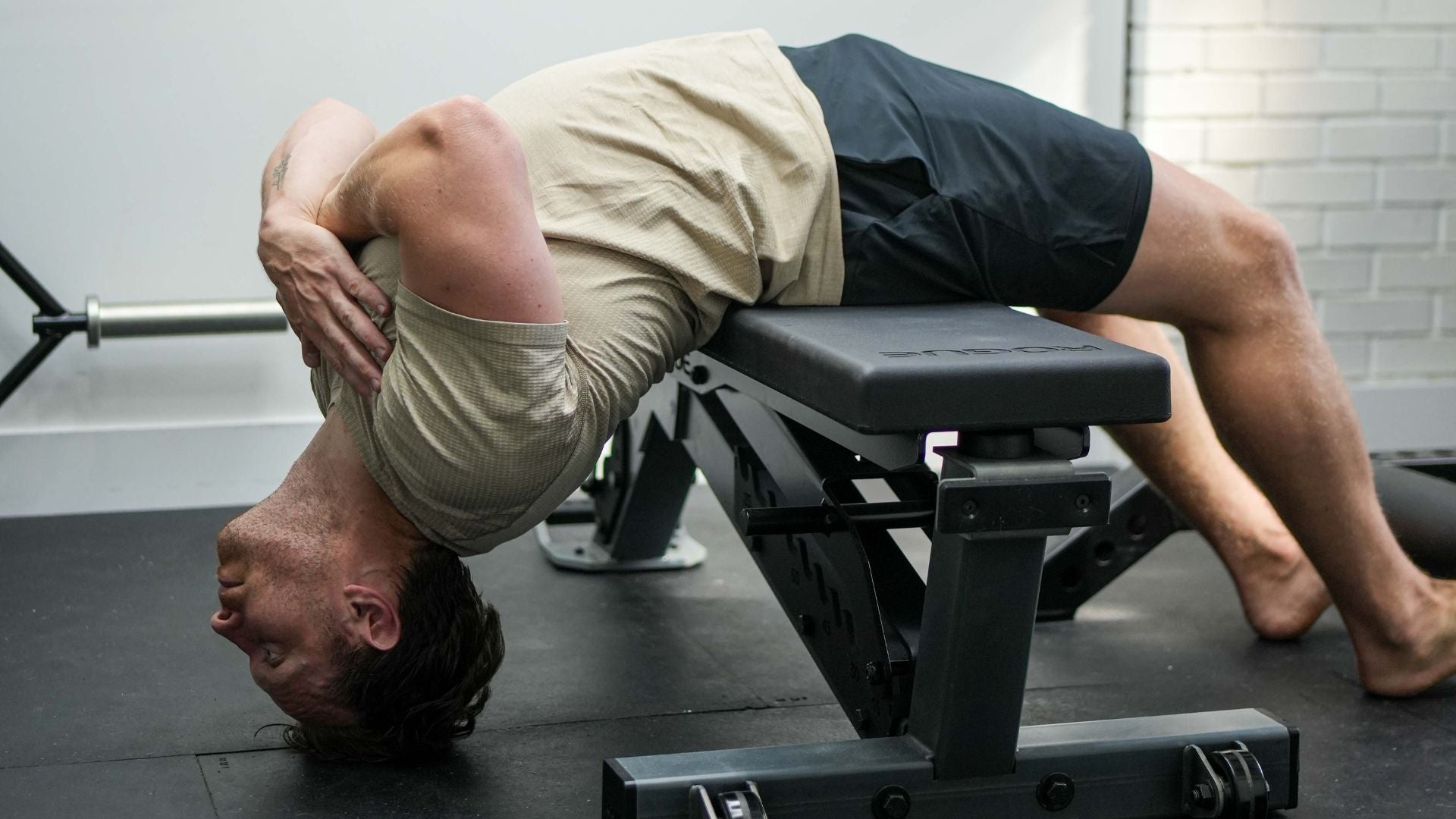
5. Bridge Sit-Up

Focus: Core and hip flexor strength
This is a challenging exercise and should be started slowly. It is excellent for building abdominal and hip flexor strength and mobility.
3 sets of 3-10 reps: 3131 tempo
How to do it:
- Sit on a flat bench with your feet anchored (have a partner hold them or wedge under something solid).
- Slide forward so your hips are near the edge and your torso can lean back into extension.
- Allow your upper body to arch slightly over the bench so your abs are stretched, arms crossed over your chest, or hands lightly behind your head.
- Slowly lower into extension for 3 seconds, pause 1 second at the bottom.
- Then hollow the core and curl up over 3 seconds into a full sit-up, finishing tall.
- Hold 1 second at the top before repeating.
- Begin with a limited range of motion. As you gain control, increase the depth of the arch. Once strong through your full range, try a single-leg version for added difficulty.
6. Seated Single-Leg Butterfly Pulses

Focus: Groin strength and hip mobility.
I’m a big fan of this drill for groin strength, resilience, and mobility. The single-leg variation adds focus and isolation.
3 sets of 10 reps per side: 2020 tempo
How to do it:
- Begin seated and cross one leg over the other in a figure-four position
- Place a light dumbbell on the elevated knee and pulse gently.
- Switch sides and repeat.
- Focus on progressing the range of motion, then increase weight.
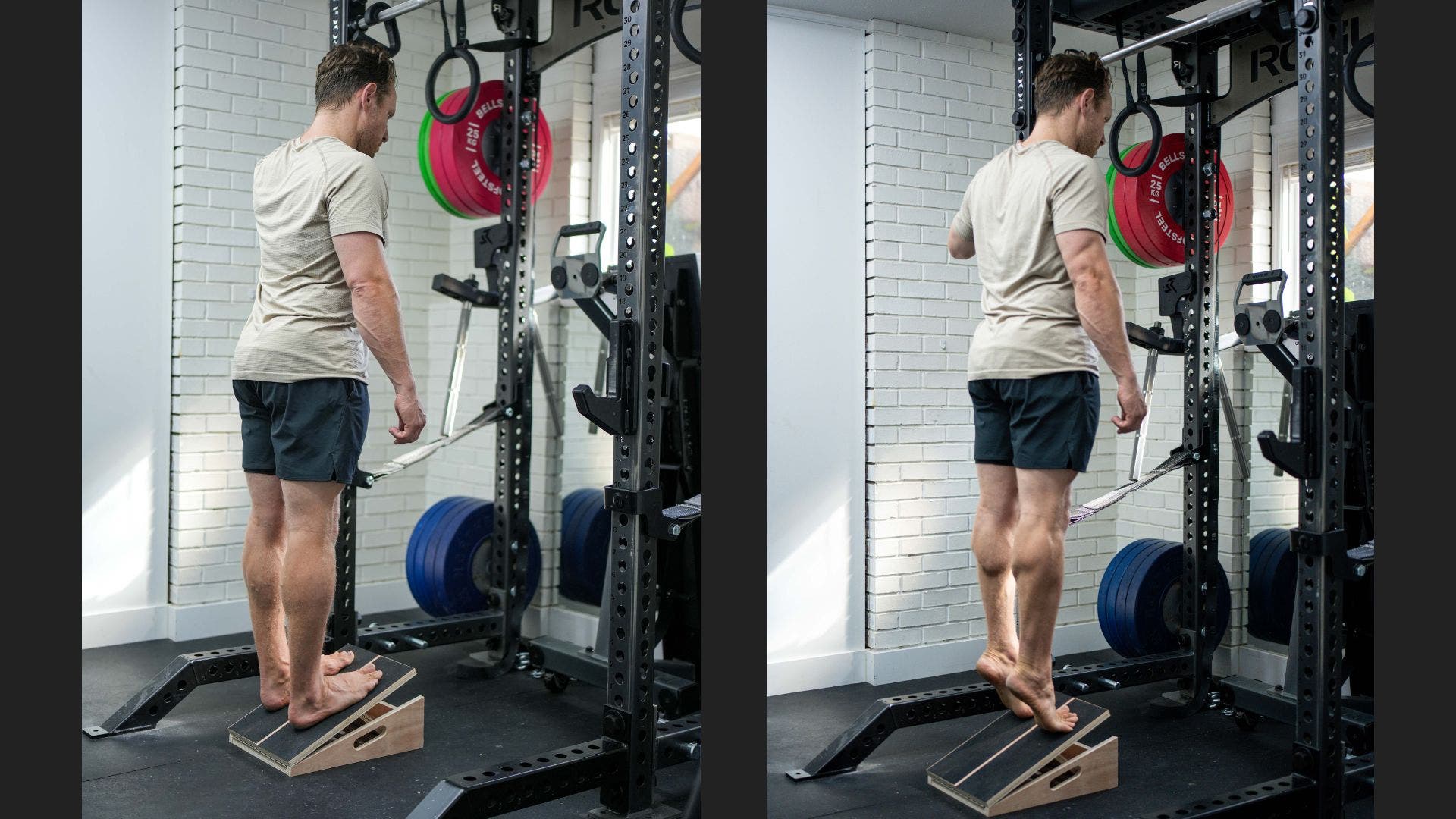
7. Calf Raises
Focus: Lower-leg strength and durability
This drill strengthens the calves, Achilles, and supporting structures of the ankle—critical for runners since every stride loads these tissues. Building stronger calves improves push-off power, reduces injury risk, and helps with running economy.
3 sets of 12–15 reps: 2121 tempo
How to do it:
- Stand on a step or weight plate with the balls of your feet planted and heels hanging off the edge. Keep your core braced and torso tall.
- Rise onto the balls of your feet over 2 seconds, squeezing your calves at the top for 1 second. Lower slowly for 2 seconds until your heels drop just below parallel for a full stretch. Pause briefly, then repeat.
